Topical authority: covering a subject, not a keyword
Topical authority is a practitioner model, not a system Google operates. It names a working assumption: a site that covers a subject thoroughly tends to do better across that subject than a site with one page aimed at one query. The assumption is reasonable and the label is useful for planning. It is not a documented mechanism.
What Google documents and what it does not
Google publishes a guide to its ranking systems, naming systems such as passage ranking, site diversity and the exact match domain system. There is no topical authority system on that list, no topical authority score, and no documented page count that establishes coverage of a subject. Anyone quoting a threshold is quoting nothing.
What Google does document is assessment above the level of a single page. Its helpful content guidance asks whether someone researching the site producing the content would "come away with an impression that it is well-trusted or widely-recognized as an authority on its topic", and whether the content gives "a substantial, complete, or comprehensive description of the topic". Those are questions about the site and about the depth of its coverage, and they are the honest basis for the idea.
Why coverage matters more in AI search
The mechanical argument got stronger with AI answers. Google's AI features guide describes query fan-out: a set of concurrent, related queries the model generates to fetch additional search results for one user question. Its example is a user asking how to fix a lawn full of weeds, which fans out into sub-queries such as best herbicides for lawns, removing weeds without chemicals, and preventing weeds in a lawn.
Read that as a retrieval problem. One prompt becomes several searches, each resolved against the index separately. A site with one page on the main question is eligible for one of those retrievals; a site that also answers the neighboring questions is eligible for several, and keeps appearing as the answer is assembled. The selection mechanics are covered in how answer engines choose their sources. Coverage here is not a bonus applied to a ranking. It is more surfaces that can be retrieved for one prompt.
Mapping a topic
Start from the sequence of questions a real buyer asks, in the order they ask them, rather than from a keyword export. An export gives phrasings; a buyer gives a path. Someone evaluating a category wants to know what the thing is, whether they need it, what it costs, how it compares to what they already use, and what goes wrong after they buy. An export sorted by phrasing will not reconstruct that order; customer conversations, support tickets and sales calls will. Volume estimates then check priority rather than supply the map, for the reasons in keyword research: intent before volume.
Deliberately include the adjacent questions competitors skip: awkward prices, failure modes, cancellation, maintenance, migration, and the cases where the honest answer is that your product is the wrong choice. These have low reported volume and high intent, and they are where a thorough site is visibly different from a shallow one.
Which questions deserve their own page
Not every question is a page. The test is narrow: a question deserves its own page when it has its own answer and its own audience. Its own answer means the response is substantial enough to stand alone rather than sit as a section in a longer page. Its own audience means someone would arrive there directly, from a search or a link, without needing the parent page first. If either half fails, the question belongs in the parent page, where it makes that page stronger. Splitting one answer across two thin pages produces two weak pages, not two chances to rank.
Hub and spoke, and the linking that holds it together
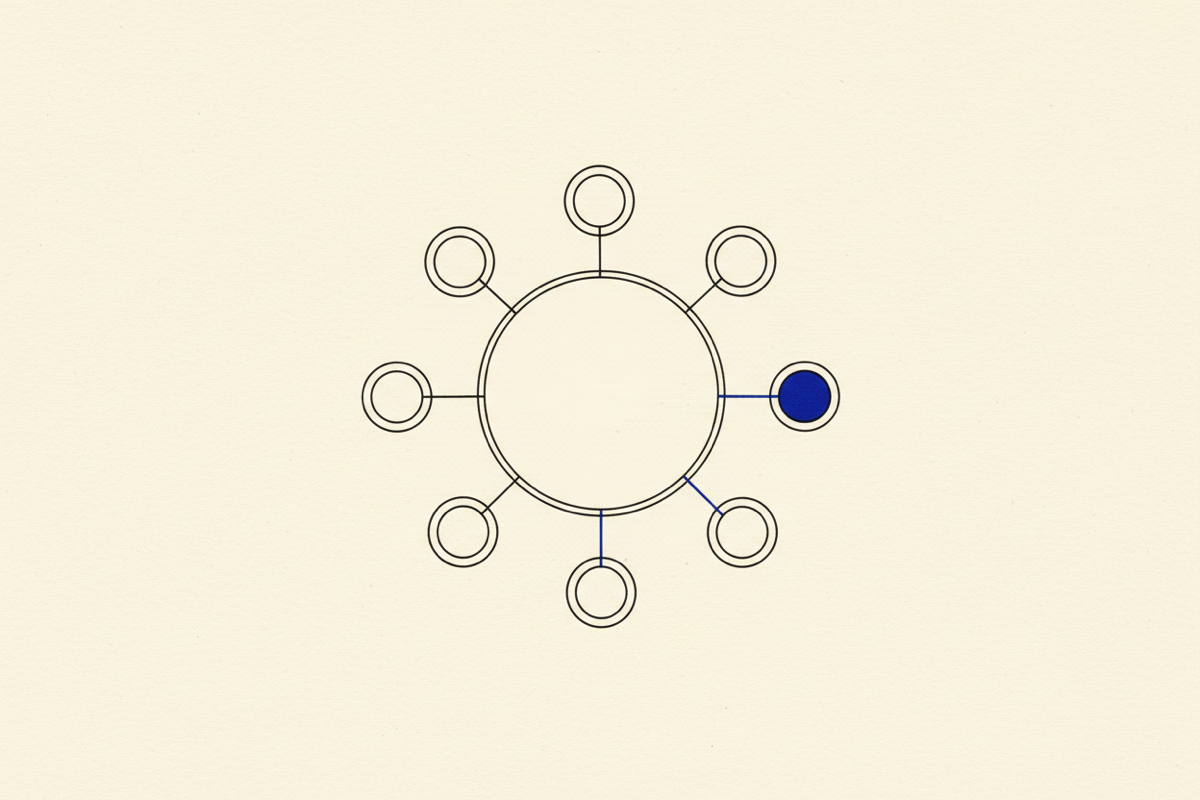
The usual structure is a hub page covering the subject broadly and spoke pages going deep on the parts that earned their own URL. The hub links down to each spoke with anchor text that says what the spoke covers, each spoke links back up, and spokes link sideways where the reader's next question sits. The mechanics belong to on-page SEO that compounds. One discipline is worth adding: the structure follows the map, not the reverse. A spoke that exists because the diagram had an empty slot is a page with no question behind it.
The failure mode: coverage measured in URLs
Topical authority is most often sold as a page count, and that is where it turns into the pattern Google's spam policies describe. The AI features guide is explicit: creating separate content for every possible variation of how people might search, including fan-out queries, primarily to manipulate rankings or generative AI responses, violates the scaled content abuse spam policy. The same passage adds that this is ineffective anyway, because "a high quantity of pages doesn't make a website higher quality or more relevant to users".
Both halves matter. The policy half is covered in thin content and the scaled content abuse policy, and the template-driven version of the same mistake in programmatic SEO done legitimately. The practical half is the definition this page rests on: coverage means answering more questions, not publishing more URLs. Forty questions answered well across twelve pages is coverage. Forty phrasings split across forty pages is the thing the policy names.
How to tell whether it is working
Two measurements, neither of them a score.
- Query breadth in Search Console. Filter Search Console to the URL path holding the cluster and count distinct queries with impressions, not clicks. If coverage is working, the number of different questions the cluster is shown for grows, including questions you never wrote a page for. If you added pages and that count stayed flat, you added phrasings rather than answers.
- Citation breadth across a prompt set. Run a fixed set of prompts spanning the subject and record how many cite the site anywhere, rather than watching one prompt. A site with real coverage is cited across neighboring prompts, not only the one it was built for. Single spot checks are unstable, so sampling method decides whether the number means anything; the setup is in measuring AI search visibility honestly.
Both are lagging measurements and both move slowly. Coverage is built one answered question at a time, and the durable version is the one where every page would still deserve to exist if the cluster around it disappeared.