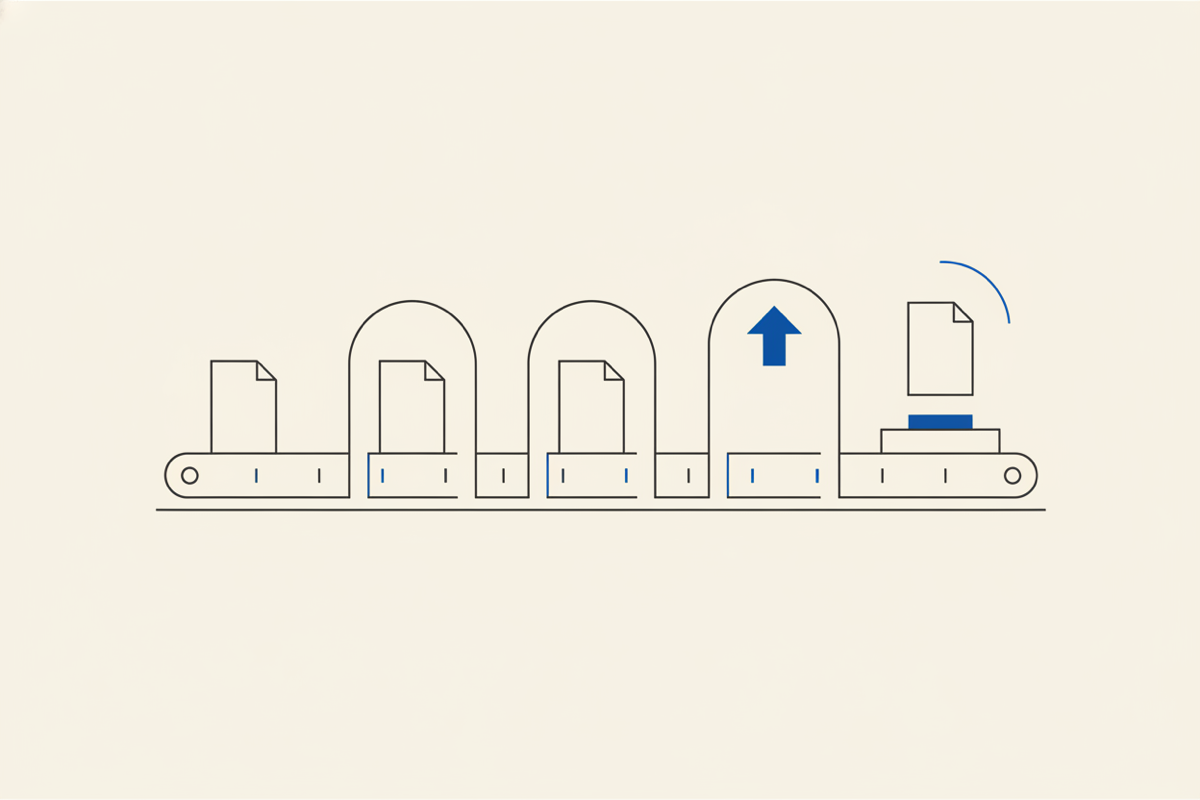
How Google ranks content
Google's ranking is often discussed as a black box, but the pipeline itself is documented and has been stable for years: crawl, index, serve. Understanding these three stages, and the quality signals applied at the serving stage, explains most SEO outcomes. It now also explains AI answers, because the same systems feed them.
Crawling: discovery
Googlebot discovers URLs through links from pages it already knows and through sitemaps you submit. It fetches each page, respecting your robots.txt rules and backing off when your server slows down. A page that cannot be fetched cannot rank, so this stage is where broken internal links, blocked resources, and server errors quietly remove content from the race. Google describes the full process in its How Search Works documentation.
Indexing: understanding and storing
After fetching, Google renders the page, including JavaScript, and works out what it is about. It also decides whether the page is a duplicate: when several URLs carry the same content, Google selects one canonical version and consolidates signals onto it. Pages with a noindex directive are dropped here. Only what survives indexing exists as far as ranking is concerned, which is why "indexed" is the first thing worth checking when a page has no visibility.
Serving: ranking the index
When someone searches, Google ranks indexed pages using many signals, which its documentation groups into a few families: the meaning of the query, the relevance of the content, the quality of the content, the usability of the page, and the searcher's context and settings. Relevance gets you into the candidate set. Quality decides the order.
Helpful content signals
Google's helpful content guidance describes the quality bar in plain terms: content should be made for people, demonstrate real knowledge of the topic, and leave the reader feeling they got what they came for. Signals of unhelpful, search-engine-first content are evaluated at the page level and can also weigh on a site as a whole, so a large volume of weak pages can drag down strong ones on the same domain.
E-E-A-T: guidance, not a switch
E-E-A-T stands for experience, expertise, authoritativeness, and trustworthiness. It comes from Google's Search Quality Rater Guidelines, the manual human evaluators use to assess whether ranking changes are working. It is important to label it correctly: E-E-A-T is not a direct ranking factor with a score attached. It is a description of what Google's systems aim to reward, which makes it useful as an editorial checklist. Show who wrote the page, show why they know, cite real sources, and make trust easy to verify.
Snippets and eligibility
The snippet is the descriptive text shown with a result, generated mostly from the page itself. You control eligibility with documented mechanisms: nosnippet, data-nosnippet, and max-snippet let you limit or block what Google may quote. This used to be a cosmetic concern. It no longer is: per Google's AI optimization guide, content must be snippet eligible to be used in AI features, so blocking snippets now also blocks citations in AI answers.
The same systems now ground AI answers
AI Overviews and AI Mode do not run on a separate index or a separate quality system. They use retrieval-augmented generation on top of core Search ranking: the model retrieves pages that rank, then writes an answer grounded in them, issuing several related queries concurrently through query fan-out for complex questions. There is no special markup to add and no AI file to publish, and Google Search ignores llms.txt entirely. Search Console includes a generative AI performance report, so you can see this surface in your own data. The practical conclusion is short: to be cited, you must rank, and to rank, everything above still applies.
This is the model Vupie builds on: crawlable sites, indexed pages, substantial articles. Next in this series: thin content and the scaled content abuse policy.