Entities: how an engine decides your brand is a thing it can name
Most advice about AI visibility starts at the page. Something has to happen first. For an engine to name your company in an answer, it must first have resolved your company as a specific thing: one organization, with attributes and relations, distinct from every other use of the same words. That step is entity resolution. When it fails, nothing written on your pages recovers it.
An entity is a resolved thing, not a keyword
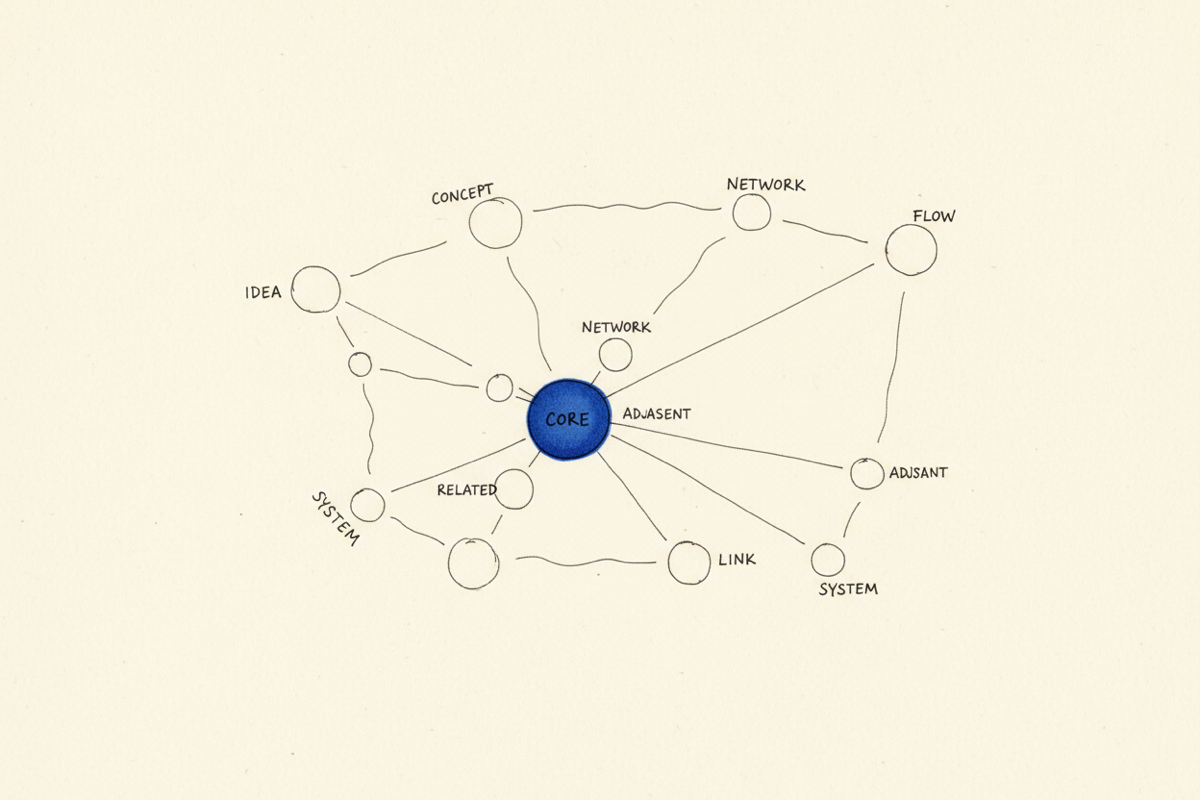
A keyword is a string of characters. An entity is a record: an identifier, a set of attributes, and a set of relations to other entities. The string "Apple" is ambiguous. The fruit and the computer company are two separate entities with different categories, different attributes and different relations, and a system that has resolved which one a question is about can answer things the string alone does not support.
Google describes its Knowledge Graph as its database of billions of facts about people, places, and things, assembled from sources that compile factual information, from licensed data, and from content owners who suggest changes to knowledge panels they have claimed. The visible surface of that database is the knowledge panel, which Google states is automatically generated, with information that comes from various sources across the web.
Where entity data comes from
Three inputs do most of the work, and only one of them is yours.
Public structured knowledge bases. Wikidata describes itself as a free, collaborative, multilingual, secondary knowledge base collecting structured data to support Wikipedia, the other Wikimedia projects, and anyone in the world. Its data is published under the Creative Commons Public Domain Dedication, so it can be reused without permission. That license is the reason Wikidata and Wikipedia statements travel so far downstream: they are the highest coverage entity data available at no cost.
Consistency across the open web. Your name, description and category appear on directories, marketplace listings, social profiles, press coverage, partner pages and conference programs. When independent sources state the same facts in similar words, a record becomes confident. When they contradict each other, the resolution is weaker and the resulting answers are less specific.
Your own markup. Google's Organization structured data documentation lists no required properties and recommends adding as many relevant ones as apply, including name, url, logo, description, legalName, alternateName, address, contactPoint, foundingDate, numberOfEmployees, and identifiers such as vatID, taxID, duns, naics, leiCode and iso6523Code. Google recommends placing this information on the home page or a single page that describes the organization, for example the about page, and says it does not need to appear on every page. The stated purpose is specific: it can help Google better understand your organization's administrative details and disambiguate your organization in search results. Google notes that some properties, naming iso6523 and naics as examples, are used behind the scenes for disambiguation, while others such as logo influence visual elements.
The sameAs property connects the records. Google defines it as the URL of a page on another website with additional information about your organization, for example a profile on a social media or review site. Listing those URLs asserts in machine-readable form that the profile and the site describe the same entity. What that markup does and does not buy elsewhere is covered in structured data: what schema actually buys you.
Why resolution decides whether you can be recommended
Ask an engine for the best option for a particular job and it returns names. For your name to be one of them, several conditions have to hold before the question is asked. The name has to exist in the model's training data or in what retrieval returns. It has to be attached to the right category. Its attributes have to match the qualifier in the question, such as a price band, an industry or a region. Google's AI features guide describes AI Overviews and AI Mode issuing multiple related queries, called query fan-out, grounded in the core Search ranking systems. Fan-out multiplies the routes by which a resolved entity can be reached, and the routes by which an unresolved one is missed.
Two failure modes account for most cases. The first is absence: nothing outside your own site describes what you are, so there is no independent material to resolve against. The second is collision: another company, product or person shares your name, and the resolved record belongs to them. Collision is the worse of the two, because the answer is confident and about somebody else. Whether your resolved name then appears in answers at all is a separate measurement problem, covered in brand mentions and share of voice.
What you actually control
- Organization markup on one canonical page, with sameAs pointing at every profile you own.
- A page that states your facts in plain sentences, including category, products, market, locations and founding details. The pattern is set out in the grounding page.
- One name, one category, one description, reused verbatim wherever you appear, including the profiles you filled in years ago and forgot.
- Corrections to third-party records that carry an old name, address or discontinued product. Most directories and review sites accept correction requests from the company itself.
- Naming what you are not, where a same-name entity exists. Stating the distinction in your own words gives every downstream source something to copy.
The limits, stated plainly
You cannot create your own Wikipedia article. Wikipedia's notability guideline presumes a topic suitable for a stand-alone article when it has received significant coverage in reliable sources that are independent of the subject, and distinguishes notability from fame, importance or popularity. The conflict of interest guideline strongly discourages editing articles you are connected to, requires paid editors to disclose employer, client and affiliation under the Wikimedia Foundation terms of use, and directs them to propose changes on talk pages and submit new articles through Articles for Creation rather than publishing directly. Notability is judged by people who do not work for you, on evidence you did not produce.
Knowledge Graph inclusion cannot be bought or requested. Google documents how to claim a knowledge panel that already exists and how to suggest edits to it. It documents no submission route for an entity that has none, and no price. No third party has access to Google's internal systems, so any product that reports your entity strength is reporting its own model, not Google's. The thresholds an engine uses to decide that a name is resolved are not published by any vendor, and nobody outside those companies can state them.